from darkness, visible light is the bright mind — harp and electronics (2026)
Commissioned by Stef Van Vynckt, duration 11’
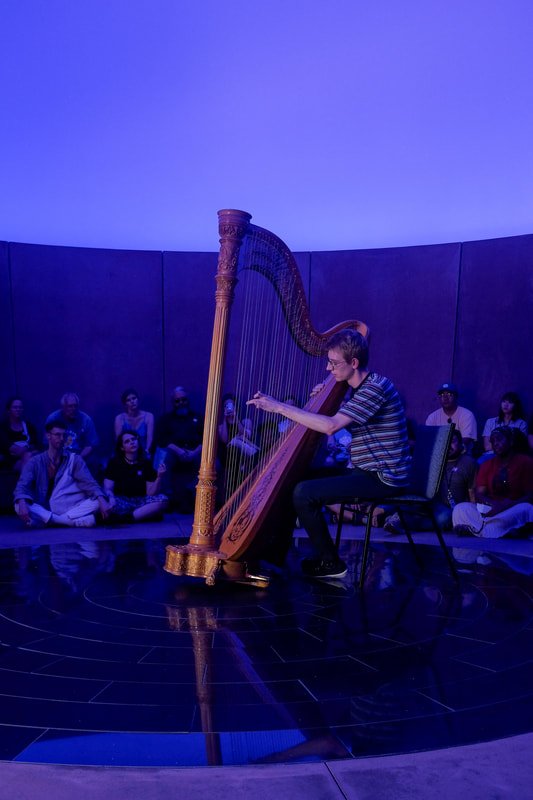
Harpist Stef Van Vynckt performing in James Turrell’s Skyspace C.A.V.U. at MASS MoCA, photo courtesy the artist.
from darkness, visible light is the bright mind was commissioned as a part of Stef Van Vynckt’s Forever — is composed of Nows — project, inspired by the musician’s time immersed in James Turrell’s works at MASS MoCA.
Over the years having spent time at MASS MoCA both as a visitor and as an artist in the Studios at MASS MoCA residency, I’ve visited the Turrell works in waves. The permanent exhibition, Into the Light, a comprehensive retrospective of Turrell’s work that lives in The Robert W. Wilson Building at MASS MoCA which was specifically designed to house Turrell’s installations.
On my last trip to MASS MoCA, after spending several hours inside the building, I ended by visiting Skyspace C.A.V.U. for the first time. The inside of the space was royal blue, and as my eyes adjusted, the otherwise gray day began to subtly glow a subtle orange outside. The weather was beginning to change and so I drove back to Copland House. As soon as I got inside, it began to pour—the whole sky opened up with large drops of rain and it was a brilliant warm orange outside as the sun set behind the rain clouds. I smiled at the idea that my day spent inside the Turrell installations had somehow changed my perception of the color of the entire sky for the rest of the day, and this experience is reflected in the material of the first movement.
The second movement responds to Turrell’s installation work Perfectly Clear—and my own synthesthetic associations. The titles of the two movements, “the sky its color” and “landscape that has no horizon,” are phrases from interviews Turrell gave as part of a Guggenheim Artist talk and on Houston Public Media, respectively.
The title of the work as a whole, from darkness, visible light is the bright mind, comes from a combination of descriptive texts for figures in the book Emblemata sacra de fide, spe, charitate (1636) by Guilielmus Hesius published by the Officina—now Plantin-Moretus Museum—in Antwerp, Belgium. Turrell reprinted these and several other figures from the original alongside his own work in his book Emblemata (2000). In an interview with Medium, Turrell said, “I use light as a material, but my medium is actually perception.”
This work was composed while in residence at Copland House, Cortlandt Manor, New York, as a recipient of the Copland House Residency Award, and was developed with support from Vlaamse Overheid Departement Cultuur, Jeugd & Media
PERFORMANCE NOTES
Electronics:
The electronics are controlled using an Ableton Live Session. The electronics consist of live processing and a fixed media part that starts halfway through the piece.
Technical Requirements:
a Macbook Pro running Ableton Live 12 Suite
an audio interface
a DPA 4099 CORE+ or similar microphone for gentle amplification/processing of harp
speakers
Alternatively, the electronics can be realized in the following way:
i. Use your own hardware or software that gives you independent control over phase modulation and pitch modulation, matching the cues in the score.
ii. Play the file named “Lanzilotti_ii-the landscape that has no horizon_fixed media.wav” as a fixed media part starting at the beginning of movement ii. If desired, a timer can be used at the start of movement two, and are included in the score as ossia.
Upcoming Performances
Saturday, October 17, 2026 — Stef Van Vynckt (harp) gives the world premiere of from darkness, visible light is the bright mind at Maison Pelgrims, Saint-Gilles, Belgium
Saturday, November 21, 2026 — Stef Van Vynckt (harp) performs from darkness, visible light is the bright mind at MIRY Concert hall, Campus Grote Sikkel, Ghent, Belgium
Friday, February 26, 2027 — Stef Van Vynckt (harp) performs from darkness, visible light is the bright mind at Oorverblindend, Drongen, Belgium
Wednesday, March 10, 2027 — Stef Van Vynckt (harp) gives the New York premiere of from darkness, visible light is the bright mind at the Lincoln Center Atrium, New York, NY